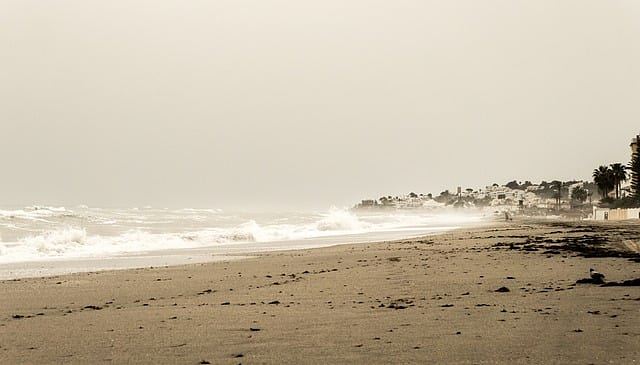
Massacre Island, Isle Dauphine, Port Dauphin,
Dauphin Island - these are some of the various names used
for almost three centuries by Europeans to identify the small
island that played such an important role in French Louisiana.
On an overcast and rainy day in early February 1699, Pierre
Le Moyne d'Iberville anchored off Mobile Bay. Finding Pensacola
occupied by the Spanish, and without specific instructions
from the crown, Iberville had moved westward to find a place
to establish the first French settlement along the Gulf coast.
As his ships approached the mouth of Mobile Bay an island
was visible to the northwest, but did it have a suitable harbor?
He dispatched two long boats, one under the command of his
younger brother, Bienville, a brash 21 year old lieutenant.
The boats returned to the ships the next day, but rain, wind,
and fog had made soundings difficult and Bienville had failed
to find the harbor.
On the following day, February 2, a break in the rain led
Iberville to investigate the harbor himself. At about two
o'clock in the afternoon, his party was met with a hard rain,
a brisk gale, and such dense fog that they could not see their
ships. By evening the soldiers were too exhausted to row back
to the ships so Iberville elected to spend the night on the
island.
The next day, February 3rd, Iberville began to explore. In
his journal he recorded finding on the "southwest end" of
the island a "spot where more than sixty men or women had
been slain." Along with the skeletal remains were "some of
their household belongings." He estimated that the remains
had been placed no more than three or four years before. Thus
with the name Massacre, Iberville succeeded in casting a spell
on the island that is still today the source of many a tall
tale.
Due, probably, to the bad weather, Iberville failed to find
the narrow pass into the harbor on the north side of Spanish
Island. Again moving westward, he built Fort Maurepas, at
the site of present-day Ocean Springs, Mississippi.
One of the original settlers, P,nicaut, a carpenter who lived
in the colony for most of the first two decades, published
an account of his experiences in 1723. Although his memory
appears somewhat clouded, he offers important and interesting
information about the early colony. On an exploration trip
to Mobile Bay from Fort Maurepas which eventually reached
Dauphin Island, P,nicaut became "terrified" after finding
such "a prodigious number of human skeletons that they formed
a mountain " He reports learning that these skeletons were
the remains of a large nation that fled to this region and
died of sickness. He indicates that the bones were gathered
together and brought to the island as part of a burial ritual.
And though the details of P,nicaut's story are suspect, his
description of this burial practice, unusual to this region,
may have some merit.
M. Le Page Du Pratz published a book in 1758 relating his
experiences and observations during his 16 years in the region
from 1718 to 1734. He spent four months on Dauphin Island
in late 1718. His description of "the bones" is far more interesting,
or fanciful, than the short, dry notes of Iberville's journal.
Iberville's "spot" becomes an "extraordinary eminence with
the dead men's bones just appearing above the sand." Du Pratz
has the Frenchmen cry out in horror, "Ah! What a Massacre!"
In his account, the unfortunate victims have been mercilessly
pursued by their enemies to their peaceful island refuge where
they are inhumanely massacred. Du Pratz even reports visiting
this "fatal monument." Written almost 40 years after he heard
the story and visited the island, the exact account must be
suspect.
In the defense of Du Pratz, he was only retelling the second
hand account of the event, which by 1718, having been told
hundreds of times, must have been popular folklore in the
colony. The vivid tale, however, surely did not hurt book
sales.
Within a short time of establishing Fort Maurepas, Iberville
realized that access to the vast river systems which led northward
from Mobile Bay were key in forging military and trading alliances
with the large local Indian societies which lived in the interior.
So in late December 1701, he issued the order to move the
colony back to Mobile Bay. The actual move began January 4,
1702. Three large tents were erected on the sandy beach just
north of the harbor and construction started on the most important
structure in the colony, the King's warehouse. A small village
grew around the warehouse, but the main own was up-river at
27 mile bluff, Old Mobile. This created a unique arrangement
between town and port that was noted by Du Pratz when he referred
to Mobile as the birthplace of French Louisiane and to Dauphin
Island as its cradle.
The growing population on the island disliked the name Massacre
finding it "harsh," and perhaps Bienville thought a new name
would bring a new image. At any rate, he decided to change
the name of the island to Isle Dauphine and the port to Port
Dauphin. In French, dauphin refers to the male heir to the
throne and his wife is the dauphine. In April, 1711, the son
of King Louis XIV (the dauphin) died, survived by his wife
(the dauphine), Marie-Ad,lacde de Savoye. Confusion existed
in France at the time as to who would ascend the throne after
Louis XIV.
The historian, Peter J. Hamilton, clearly outlined this situation
in his 1910 work, Colonial Mobile, although he concluded that
Bienville had named the port and the island for the heirs.
The fact remains that in his official report Bienville did
not mention that the name change referred to any specific
individual.
In French many words have gender usually expressed in their
endings. Nouns and adjectives must agree. In French the noun
for island is female agreeing with dauphine, and port is masculine
agreeing with dauphin.
It is even possible that Bienville was referring to the French
name for a fish. If he was referring to the heir to the French
throne, he could have been doing it in a generic sense. Like
the myths that have built up around the name "Massacre," the
believe persists that Bienville named the island for the female
heir to the French throne.
The historian, Jay Higginbotham points out that when Louis
XIV approved the name change in 1712, the king assumed the
name had been chosen to honor the heirs to the throne. However,
other historians such as Marcel Giraud and Richebourg Gaillard
McWilliams concluded that Bienville did not intent to honor
any specific person, but intended to honor the title the way
we might choose the name Royale for a street. The fact is
we may never be sure. In time the ending 'e' was dropped in
a more Anglicized form of the name to its present form, Dauphin
Island.
So, what's in a name? Myth, fantasy, fact, one thing is certain
- Dauphin Island can rightfully claim an important and colorful
place in the history of French Louisiane as the oldest permanently
occupied settlement in the region.